AI Embeddings Explained: How Machines Grasp Meaning
Learn what AI embeddings are, how they turn words into vectors that capture meaning, and how they power semantic search, RAG, and smart recommendations.
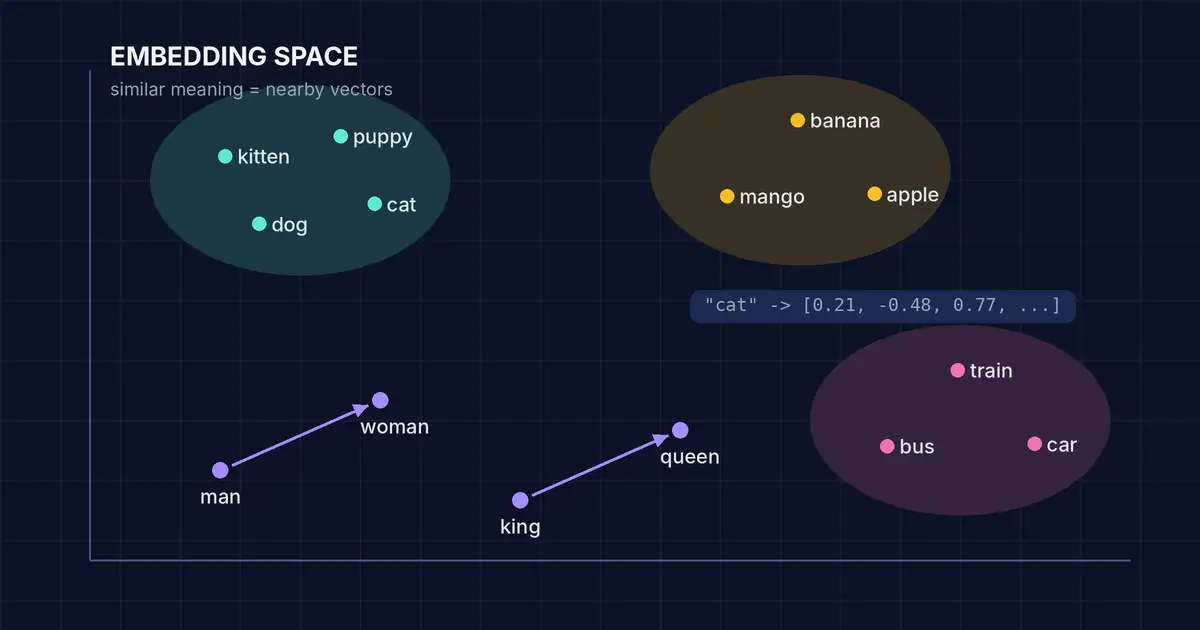
Search for "cheap laptop" and a smart search engine also shows results for "affordable notebook", even though the two phrases share no words. The trick behind this is called an embedding. Embeddings are one of the quiet building blocks of modern AI, and once you understand them, a lot of AI products start to make sense.
What is an embedding?
An embedding is a list of numbers, called a vector, that represents the meaning of a piece of content. That content can be a word, a sentence, a whole document, or even an image.
A model reads the text and outputs something like [0.21, -0.48, 0.77, ...]. Modern text embeddings usually have hundreds to a few thousand of these numbers. Each number on its own means little. Together, they place the text at a specific point in a high-dimensional "meaning space".
Google's Machine Learning Crash Course on embeddings is a good visual introduction if you want to go deeper.
Why similar meanings end up close together
Embedding models are trained on huge amounts of text. They learn that words appearing in similar contexts tend to mean similar things. As a result, "cat" and "kitten" land near each other, while "cat" and "invoice" end up far apart.
The famous king and queen example
In 2013, researchers at Google released Word2vec, an early and influential embedding method. It showed something surprising: directions in the space can carry meaning. Taking the vector for "king", subtracting "man", and adding "woman" gives a result very close to "queen".
Today's models are far more advanced, but the core idea is the same. Meaning becomes geometry.
Measuring closeness
To compare two embeddings, systems usually calculate cosine similarity, which checks how closely two vectors point in the same direction. A score near 1 means very similar meaning. A score near 0 means unrelated.
Where embeddings are used
Semantic search: find results by meaning, not exact keywords.
RAG (Retrieval-Augmented Generation): a chatbot looks up the most relevant passages from your documents before answering. We explain the full flow in our article on what RAG is.
Recommendations: suggest articles, products, or songs similar to what someone already liked.
Clustering and tagging: group thousands of support tickets or reviews by topic automatically.
Duplicate detection: spot near-identical questions or content written in different words.
Tips for working with embeddings
Use the same model for everything you compare. Vectors from different models live in different spaces, so mixing them gives meaningless scores.
Split long documents into chunks. One vector for a 40-page PDF blurs everything together. Chunks of a few paragraphs usually retrieve much better.
Store vectors in a vector index. For small projects, an array in memory is fine. For more data, extensions like pgvector let you search vectors directly inside PostgreSQL.
Pick a model that fits your language and task. The MTEB leaderboard on Hugging Face compares many models, including multilingual ones that handle Indonesian. Open-source options are available through Sentence Transformers, and hosted APIs such as the OpenAI embeddings guide show how to get started in a few lines.
Re-embed when you switch models. Upgrading the model means regenerating every stored vector, so plan for it.
Embeddings turn "what does this mean?" into "how far apart are these points?"
Embeddings are not understanding
Embeddings capture patterns of usage, not true comprehension. They can mirror biases in their training data, and two sentences can look similar while meaning opposite things, such as "the test passed" and "the test did not pass". Always check results on real examples from your own data.
Keep exploring
Embeddings work hand in hand with other AI basics. Learn how models split text into pieces in our guide to AI tokens, see why retrieval helps reduce AI hallucinations, or explore the AI projects we build at Ryuartistry.