AI Tokens Explained: How Language Models Read Text
What a token is, why 1 token is roughly 4 characters of English, how context windows and pricing depend on it, and tips to use fewer tokens in prompts.
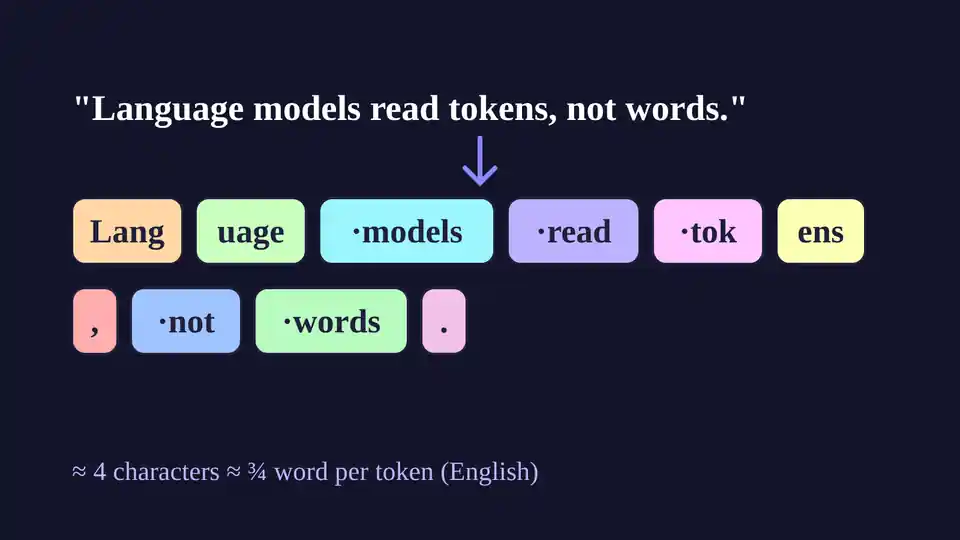
When you chat with an AI model, it does not read your message letter by letter or word by word. It reads tokens. Understanding tokens helps explain why models have length limits, why some prompts cost more than others, and why the same sentence can weigh differently in different languages.
What is a token?
A token is a small chunk of text that a model treats as a single unit. It can be a whole word ("read"), part of a word ("tok" + "ens"), a punctuation mark, or a word with the space in front of it. Before the model sees your text, a tokenizer splits it into these pieces and turns each one into a number.
How text gets split
Most modern language models use subword methods such as byte pair encoding (BPE). The tokenizer learns which character sequences appear often in its training data and gives them their own token. Common words become one token, while rare words, names, and typos are broken into several. The Hugging Face tokenizer guide walks through the main approaches.
A handy rule of thumb
For English text, OpenAI estimates that one token is about 4 characters, or roughly three quarters of a word. So 100 tokens is around 75 words. You can see the split yourself with the OpenAI Tokenizer. Other model families use different tokenizers, so treat this as an estimate, not a fixed rate.
Why tokens matter
The context window
Every model has a context window: the maximum number of tokens it can consider at once. That budget covers your prompt, attached documents, the conversation history, and the model's own reply. Anthropic's documentation on context windows explains how input and output share this space.
Cost and speed
Most AI APIs bill per token, often with different prices for input and output. More tokens also mean more computation, so very long prompts can be slower to answer.
Language differences
Tokenizers are usually trained on data dominated by English, so other languages often need more tokens to say the same thing. The 2023 study "Language Model Tokenizers Introduce Unfairness Between Languages" found that the same text translated into some languages can take several times more tokens than in English. For Indonesian content, it is worth measuring instead of assuming.
Tips to use tokens wisely
Be specific, not long. One clear instruction beats three paragraphs of background.
Trim repeated context. Avoid pasting the same document into every message of a conversation.
Ask for the format you need, such as "five bullet points" or "under 100 words", to keep replies short.
Clean your input. Remove boilerplate, menu text, and duplicate lines before sending a document.
Measure, do not guess. Run a sample through a tokenizer before estimating cost.
Think of tokens as the model's unit of attention: every one you send should earn its place.
Keep exploring
Knowing how tokens work makes it easier to write effective prompts. Continue with our guide to better prompts with context, format, and examples, and see how compact instructions power small AI agents that are actually useful. More AI experiments are waiting on Ryuartistry.